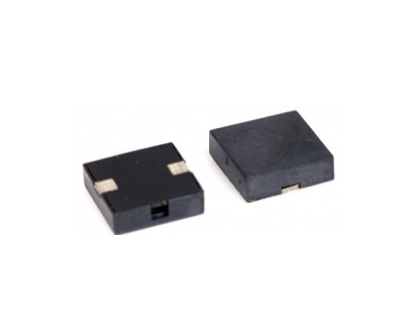


What is a piezo ceramic buzzer?
 Oct 16, 2025|
 View:806
Piezo Ceramic Buzzers are compact electronic devices that convert electrical energy into audible sound using the piezoelectric effect. These components have become ubiquitous in modern electronics, serving as reliable and efficient sound producers in everything from simple household appliances to sophisticated industrial equipment. Their unique operating principle and practical advantages make them an essential component in countless electronic designs worldwide.
The Working Principle: Harnessing the Piezoelectric Effect
The core functionality of piezo ceramic buzzers stems from the piezoelectric effect, a physical phenomenon discovered in 1880 by Jacques and Pierre Curie. This effect describes the ability of certain materials to generate an electric charge when mechanical stress is applied, or conversely, to undergo mechanical deformation when an electric field is applied .
In a piezo buzzer, this principle is applied inversely. When an alternating current (AC) voltage is applied to a piezoelectric ceramic element, the material's internal lattice structure deforms slightly, causing it to vibrate mechanically . These vibrations are transferred to a metal plate or diaphragm attached to the ceramic element, causing it to bend and push against the air, thereby generating sound waves . The frequency of the applied voltage determines the pitch of the sound produced, with the loudest sound occurring at the buzzer's resonant frequency .
Key Components and Structure
A typical piezo ceramic buzzer consists of several key components:
Piezoelectric Ceramic Element: This is the active material, often made from man-made ceramics like lead zirconate titanate (PZT) . When voltage is applied, this element expands and contracts.
Metal Plate/Diaphragm: The piezoelectric ceramic is bonded to a metal plate, which amplifies the tiny vibrations from the ceramic to produce audible sound .
Resonant Cavity and Case: The vibrating assembly is typically housed in a plastic case that acts as a resonant cavity, amplifying the sound pressure and directing the sound waves . The case often includes a sound release hole to allow the sound to escape effectively.
Types of Piezo Ceramic Buzzers
Piezo buzzers are generally categorized into two main types based on their driving method:
Active Buzzers (Self-drive): These buzzers have a built-in oscillation circuit . They only require a simple DC power supply to produce sound at their predetermined resonant frequency, making them easier to implement but less flexible .
Passive Buzzers (External-drive): These buzzers require an external driving signal, typically a square wave or PWM signal from a microcontroller . They offer more control, allowing the user to vary the frequency to create different tones and melodies, but require a more complex drive circuit .
Technical Specifications and Performance
Piezo buzzers are available in various specifications to suit different applications. Common models operate at voltages ranging from 1.5V to 30V DC and produce sound pressure levels of ≥85 dB at a distance of 30cm . Their resonant frequency typically falls between 1.8 kHz to 3.5 kHz, which is within the range of human hearing that is most sensitive .
These devices are known for their low power consumption, often drawing less than 30mA of current, which makes them ideal for battery-powered applications . They also offer a wide operating temperature range (typically from -20°C to +70°C), making them suitable for various environments .
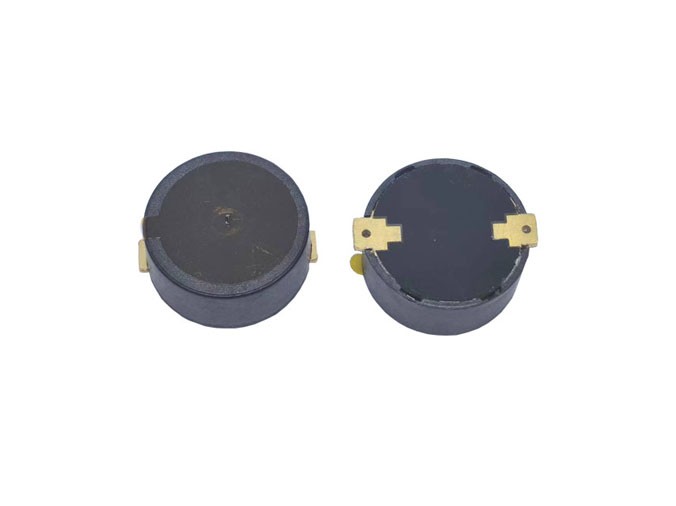
Advantages and Applications
The popularity of piezo ceramic buzzers stems from their compelling advantages over other sound-producing technologies:
Small size and low profile, with some SMD models being as small as 9.6x9.6x5mm .
High reliability and long life (over 10,000 hours) due to having no moving contacts or electromagnetic coils that can wear out .
Low power consumption, making them ideal for portable, battery-operated devices .
High sound output relative to their small size .
Cost-effectiveness and simple construction .
These advantages make piezo buzzers suitable for a wide range of applications, including:
Alarms and alerts in security systems, smoke detectors, and medical equipment .
User interface feedback in appliances, computers, and automotive electronics (e.g., reversing sensors) .
Consumer electronics such as toys, watches, and home appliances .
Industrial equipment for status indication and warnings .
Practical Considerations for Use
When implementing piezo buzzers in designs, several important precautions should be observed:
Avoid applying DC voltage directly, as this can damage the ceramic element and impair performance .
Do not exceed the maximum operating voltage specified for the buzzer .
Protect from mechanical stress and pressure on the sound generator, as the piezoelectric ceramic is fragile (approximately 100μm thick) and can crack easily .
Consider the driving circuit. For applications requiring higher volume, a boost converter circuit (like the TLV61046A) may be needed to increase the driving voltage amplitude, thereby increasing the sound pressure .
Avoid using in corrosive environments or with solvents, as these can damage the buzzer's components .
Piezo ceramic buzzers represent a remarkable convergence of materials science and electronic engineering. Their ability to efficiently convert electrical signals into audible sound through the piezoelectric effect has made them indispensable components across countless industries. As technology advances, these devices continue to evolve, offering improved performance, smaller form factors, and greater integration capabilities for the next generation of electronic products. Whether providing critical safety alerts or simple user notifications, the piezo ceramic buzzer remains a fundamental solution for audible feedback in our increasingly connected world.