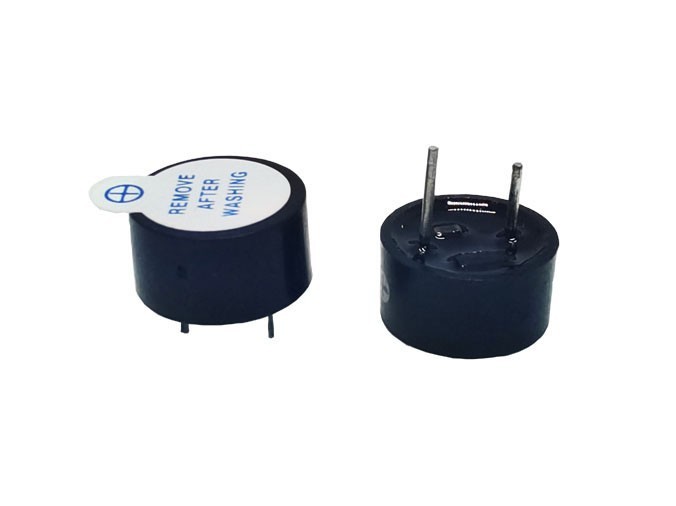


Which is better, an active or passive buzzer?
 Jul 21, 2025|
 View:1121
In the realm of electronics, where microcontrollers whisper logic and sensors observe the world, sometimes you just need to make some noise. A simple alert, a warning beep, a melody snippet – buzzers are the workhorses of auditory feedback.
1. Core Distinction: The Source of Sound
This is the root of their difference, governing everything else.
Active Buzzer: The Self-Contained Unit
Think: All-in-one module.
How it Works: An active buzzer houses both the piezoelectric transducer AND the oscillator circuitry needed to drive it at a specific fixed frequency. Internally, it's like having a tiny sound generator IC attached directly to the piezo element.
The Result: You supply a steady DC voltage to its power pins, and it instantly produces its characteristic sound – usually a loud, consistent tone like a continuous beep .
Passive Buzzer: The Pure Transducer
Think: Loudspeaker for tones.
How it Works: A passive buzzer contains only the core sound-producing element – most commonly a piezoelectric disc. It lacks any internal oscillator.
The Result: It doesn't produce sound with simple DC. To make it beep, you must feed it an oscillating signal – typically a square wave – generated by an external circuit, microcontroller pin, or driver transistor. Its sound reflects the waveform you input.

2. Diving Deeper: Characteristics & Trade-offs
Understanding how they work leads directly to how they perform and how you interact with them.
Sound Generation & Control:
Active:Plug-and-Play Simplicity. Apply DC voltage → get fixed tone. Minimal effort required from the driving circuit. Ideal for basic alerts where only one sound is needed.
Passive:Requires Drive Circuitry. Needs an external oscillating signal. Significantly More Flexible. You can:
Vary the frequency to produce different tones/pitches.
Vary the duty cycle to subtly change timbre or create effects like siren wails.
Generate complex sequences and melodies by changing the frequency over time.
Tone:
Active: Fixed at one manufacturer-specified frequency . Loud, piercing, monotone .
Passive: Variable frequency determined by your input signal. While often similar in raw volume to active buzzers, the pitch can change.
Driving Complexity:
Active:Extremely Simple. Drive it like an LED. A microcontroller pin can often sink/source enough current directly, possibly requiring a small series resistor. A transistor driver is safer for higher-power buzzers or microcontrollers with low current output.
Passive:Requires Signal Generation. Needs an oscillating signal. While trivial for a microcontroller generating PWM or a simple 555 timer circuit, it requires active signal generation capabilities that the active buzzer provides internally. You still likely need a transistor driver to provide sufficient current, as the microcontroller pin usually drives the base/gate, not the buzzer directly.
Standing Current:
Active: Consumes constant current whenever power is applied, whether buzzing or not. This can be significant for battery-powered applications if the buzzer state isn't strictly controlled.
Passive: Only consumes significant current when actively driven by the oscillating signal. When the signal stops, current draw drops dramatically. Much better for battery life if the sound is intermittent.
Turn-On/Off Behavior:
Active: Starts sounding almost instantly upon applying DC voltage. Stops almost instantly when voltage is removed.
Passive: Sound onset corresponds precisely to the applied signal. To stop sound instantly, you must stop the oscillating signal. Applying a DC voltage will not produce sound and could potentially damage it over time.
Identification (Simple Test):
Voltmeter Test: Connect a DC voltmeter to the pins. If you see low resistance, it's likely Passive. If you see high resistance, it's likely Active.
Voltage Test: Connect to appropriate DC supply briefly. If it buzzes, Active. If silent, Passive.

3. Application Showdown: Choosing the Right Tool
When to Choose an Active Buzzer:
Simple Alert Systems: Doorbells, microwave oven "done" signals, timers, basic alarms. Where only one loud, distinct beep is required.
Minimal Hardware/Debugging: Projects needing sound without spare microcontroller PWM pins or extra driver circuitry complexity.
Simplicity Priority: Prototypes or designs where quick implementation is key.
Battery Life Not Critical: If the DC voltage is switched off when silent, the standing current drain is eliminated.
When to Choose a Passive Buzzer:
Multi-tone or Melodic Applications: Toys, musical gadgets, complex alarms with different patterns , notification sounds requiring pitch variations.
Dynamic Sound Generation: Sirens, variable frequency alerts.
Strict Battery Life Requirements: Applications where every microamp counts; only draws significant current when actively producing sound.
Greater Flexibility Needed: Projects where the sound characteristics might evolve or require precise control later.
Low-Frequency Sounds: Active buzzers are typically optimized for 2-4 kHz; passive buzzers can be driven at lower frequencies.

4. Practical Considerations
Volume: Both types offer comparable SPL ratings (80-95+ dB common). Check the datasheet! SPL depends on voltage, resonance, enclosure, and distance. Active buzzers achieve their loudness easily. Passive buzzers need sufficient drive current to reach their rated SPL.
Cost: Passive buzzers themselves are often marginally cheaper. However, factoring in the required drive circuitry, active buzzers can be simpler and potentially more cost-effective overall for basic apps. Passive wins on per-component cost, Active often wins on BoM/circuit simplicity cost for single-tone uses.
Resonance: Passive buzzers often have a specific resonant frequency where they are most efficient and loudest. Driving them near this frequency optimizes performance. Active buzzers have this resonance tuned internally by their fixed oscillator.
Connections:Polarity matters! Active Buzzers are polarized; +DC and GND connections are crucial. Most Passive Buzzers are unpolarized for the AC signal, though some might have polarity markings for phase consistency. Always verify the datasheet or product labeling!